> For the complete documentation index, see [llms.txt](https://docs.alemba.com/asm-hermes/llms.txt). Markdown versions of documentation pages are available by appending `.md` to page URLs; this page is available as [Markdown](https://docs.alemba.com/asm-hermes/setup-and-configure-asm/configuring-your-system/workflow-template-administration/managing-tasks-adding-tasks-to-the-dependency-diagram/task-types-in-the-task-palette/creating-a-closure-task.md).
# Creating a Closure Task
Closure tasks mark the end of a request. A Closure task can be used to set the implementation reason and request status for a request.
A request can have multiple Closure tasks depending on the workflow path. They can be automated or manually run by an analyst.
{% hint style="warning" %}
If the request does not have a closure task, the request manager must manually close the request.
{% endhint %}
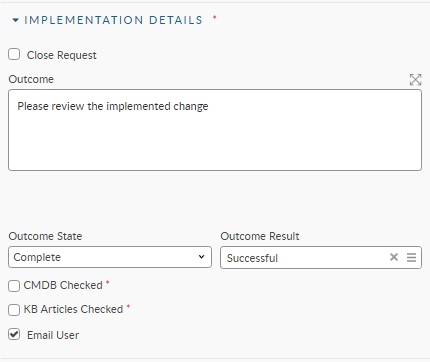
You have the same options for closing the request within a closure task as you do when performing the completion within the request itself. Success and failure can still be specified, as can additional information about the nature of the success or failure and descriptive information. Email notifications can also be sent.
Example: This screen can be customised in Screen Designer in order to capture exactly the information needed.
{% hint style="info" %}
If a closure task becomes active and attempts to close a request while it is currently being actioned on by the request manager, the closure task will automatically complete once the request is free. A note will be added to the task history stating that the completion of the closure task has been delayed due to the request being locked.
{% endhint %}
### Creating a Closure Task
1. On the **dependency diagram**, double-click the icon to view the **Change Window Task Details** window.
2. Complete the common task fields on this task. ***See Also:*** [***Creating a Task***](https://docs.alemba.com/asm-hermes-10.6.8/setup-and-configure-asm/configuring-your-system/workflow-template-administration/steps-for-workflow-request-template-creation/managing-tasks-adding-tasks-to-the-dependency-diagram/task-types-in-the-task-palette/creating-a-task)
3. Expand the **Implementation Details** section to set the request closure parameters.
4. After you have completed the fields, save the task